FORECASTING ME
a self-trend report
Designers inherit paradigms long before they learn to name them. This project applies trend-forecasting methodologies reflexively, treating individual evolution as a site where broader design discourses accumulate, distort, and shift. By mapping my own trajectory through three archetypes, I test whether tools built to read cultural movement can also make visible frameworks we absorb, perform, and eventually question.
The project functions as both reflection and method, and asks: if we can forecast design futures, can we forecast ourselves? And if shifts in personal practice surface before they are fully articulated in the discipline, what can that reveal about where design is heading?
From a two-day ego-trends workshop in my MA study.
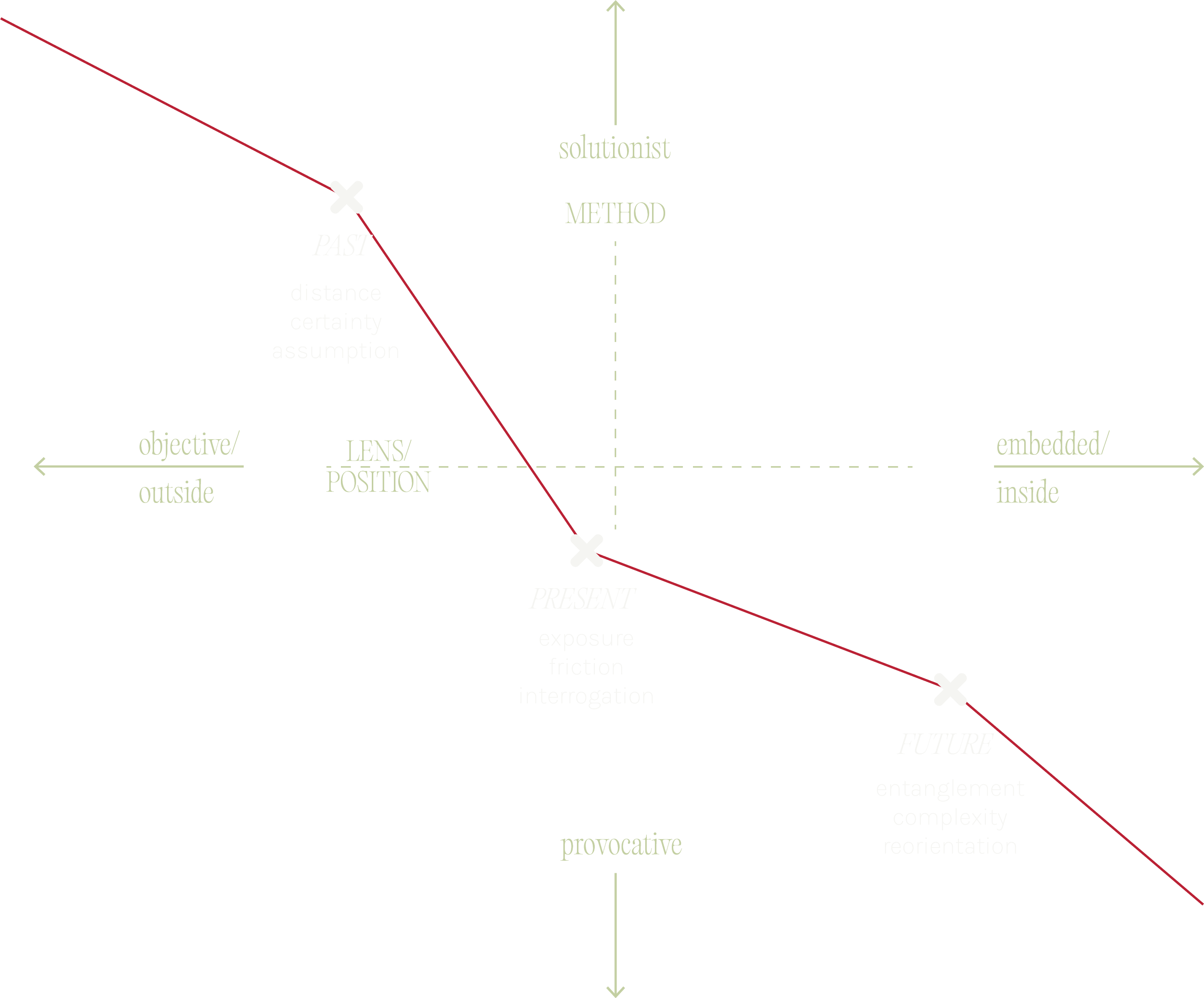
I began in industrial design, where the framework was clear and rarely questioned: design identifies problems, produces neat solutions, and communicates them through compelling narratives. Even as my work and education drifted towards complexity and systems research, the underlying structure remained: design positioned outside the context, diagnosing with presumed neutrality. This cast the designer as a detached authority, and within that logic, I unquestioningly believed in my own objectivity, as I lacked the vocabulary to even consider positionality or internal bias.
For a designer fresh out of school, this structure felt reliable, generating a palette that was young, easygoing, and hopeful. The default posture was detached, confident, and pitch-ready: slap an app on it, make it sellable, make it legible.
PAST
2016-2022
A belief system where design, as a problem-solving tool, could enact real change, through the designer’s supposedly privileged sight.
Hope /
Signals
CORE
ARCHETYPE:
design-as-authority
‘objective’
solutionist
accessible
overview
palatable
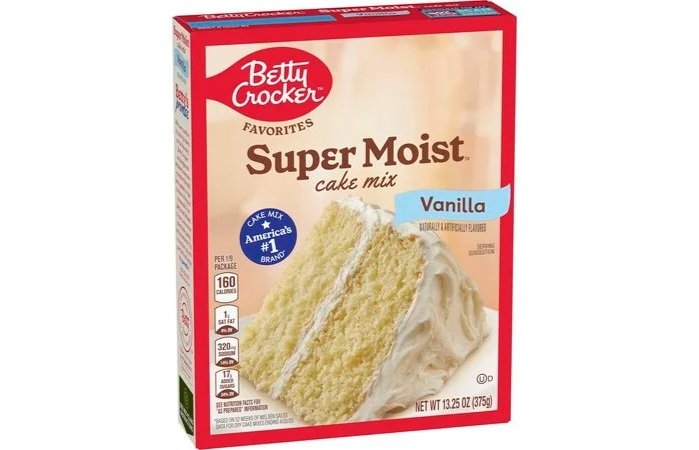
Pre-Packaged
Vanilla Cake
Pre-Packaged Vanilla Cake operates within a paradigm of polished prototypes and neatly packaged narratives. Design evolved from naïve solutionism towards systemic diagnosis, occasionally tipping into experiential speculative work. Research is often presented in a sterile setting, using approachable aesthetics to cater to a wide audience. Content is cute, smoothed-out, bite-sized, and digestible.
The production churn became increasingly mindless – another pitch, another “sustainable” fix piled on top of an unchanging system. Product work felt shallow; systems mapped complexity without offering ways to engage with them.
Design felt like a cookie-cutter tool wielded with unexamined authority and objectivity where none existed. The sense of stuckness grew, along with a desire to understand and engage with systems more deeply, pushing me back into study.
Frustration /
Drivers
Graduate school arrived as a disorienting recalibration. Critical theory exposed the limits of the neutrality and authority I had taken for granted, and made the assumptions of my previous practice suddenly visible. The framing could contain nuance; designers were embedded in the systems they critiqued. I began metabolising dense theory while still learning its language – talking through concepts I hadn’t fully grasped, wrestling with ideas that felt urgent but still slightly beyond reach.
The work became exploratory and conceptual, often leaning heavily on theory, as I wasn’t yet able to fully translate it into grounded form. The palette was developing, caught between what I'd left behind and what I hadn't yet become.
PRESENT
2022-2024
New conceptual tools marked the beginnings of a more situated practice. Questioning positions, making visible what had been naturalised, and translating theory into subjectivity brought a sense that critique could orient design rather than replace it altogether.
Hope /
Signals
CORE
ARCHETYPE:
design-as-storytelling
subjective
theoretical
abstract
opaque
ironic
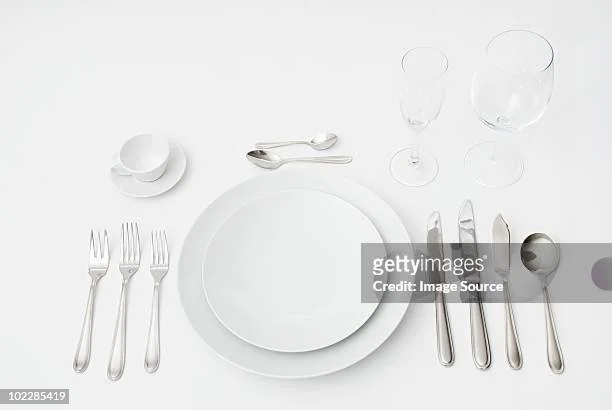
Reservation at
Empty Gourmet
Reservation at Empty Gourmet reflects an approach seeking to destabilise current systemic frameworks and imagine alternative ways of being through theoretical and comparative abstractions. The work wrestles with language and form while still metabolising the frameworks it engages with. Research is translated into material or performative gestures and illustrations that centre subjectivity, and intuitive interpretation.
Digestion began catching up, though the work remained uneven. Positions became firmer, impostor syndrome eased, and I stopped only consuming discourse and started, tentatively, contributing to it. The frustration with staying purely theoretical grew; I didn't want to disappear into an echo chamber where theory talks only to itself. The desire emerged to locate my own position clearly, and carve a practice that was neither solutionist nor purely abstract.
Emerging Patterns:
Defining future movements is both prediction – where my trajectory seems to be heading based on solidifying patterns – and prescription – where I’m deliberately steering the work. Design is framed explicitly through the subjective position and presented as narrative, with no claims to truth. In this framework, design does not spoon-feed needless solutions but provokes movement by challenging complacency and holding complexity rather than collapsing into resolution.
The practice continuously disentangles from inherited modernist orientations, without pretending to fully escape them. Instead, it works to make visible what frameworks carry, what they enable, what they foreclose. The designer takes the reins: confident enough to own their position, sit with nuance, and centre myth and speculation explicitly.
FUTURE

CORE
ARCHETYPE:
design-as-provocation subjective
critical
explicitly mythic
post-ironic
situated
complex
tangible/abstract
Anti-Blind-Tasting metabolises abstraction as a navigational tool, positioning design as a means of reframing and disentangling from dominant modernist orientations. The work provokes reflection rather than clean resolution, holding space for complexity and nuance. It uses design as both critique and mediation, to rethink inherited sensibilities and nurture conditions where change becomes imaginable again.
Anti-Blind-Tasting:
Decolonising the Palette
This isn’t a resolved position but an orientation that required continual recalibration. Provocation can drift into comfortable posturing if tensions aren’t consciously managed. The work ahead lies in reflexively narrowing the gaps that shape this trajectory:
MOVEMENT
Abstraction can reorient perception, while also remaining gestural. The task is to keep pulling ideas toward forms that actually shift how things are seen, interpreted, or approached—to go beyond atmospheric critique.
Abstraction vs consequence
Rejecting false neutrality doesn’t absolve looseness. Subjective positioning must strive for clear, accountable, and defensible communication, rather than dissolving into aestheticised relativism.
Subjectivity vs rigour
Stepping away from dominant frameworks is necessary, but not at the expense of participation. The practice must stay legible enough to invite others in, rather than receding into a closed loop of people already fluent in the discourse.
Critical distance vs insularity
The work needs to hold layered thinking while still remaining communicable—complex, but not impenetrable.