PRIMORDIAL SOUP
Towards Metabolic Practice
{{ work in progress }}
methodological continuation of Monstrous Earth
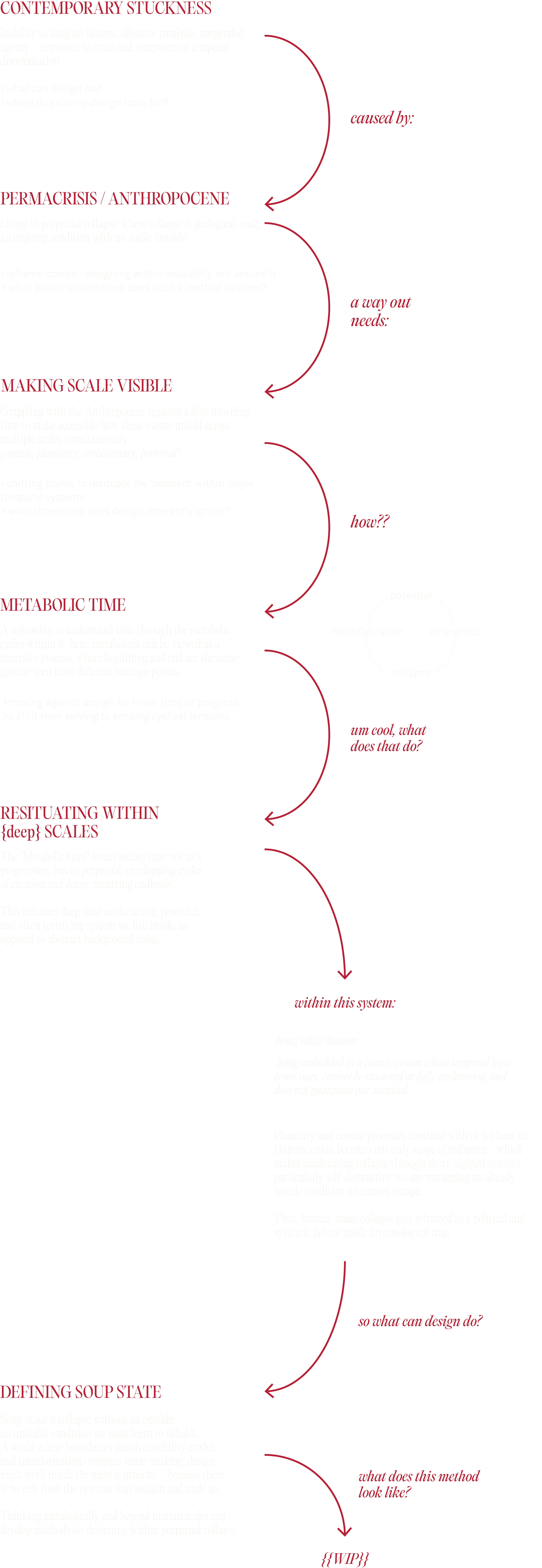
We are no longer designing for a stable world. Collapse is not an edge case but the environment we now inhabit. Design must adapt its assumptions to this condition and develop practices for working within ongoing instability — acknowledging that transformation is continuous, that systems exceed our control, and that stability itself is no longer a meaningful ground to design upon.
Premise
Decentering the human is perhaps the most human-centered choice we can ethically make today. In the midst of ever-worsening ecological, political, financial, and affective collapse, imagining livable futures feels increasingly bleak. This isn’t just emotional exhaustion, but a signal of deeper temporal dissonance – of being embedded in planetary systems indifferent to human survival, while inhabiting societies centered on extraction, short-term gain, and ecocidial practices. The combination is particularly cruel: we exist inside inhuman scales we cannot escape, while accelerating our own dissolution within them.
Primordial soup foregrounds this double bind: planetary metabolism that exceeds us and human-made systems that worsen our already-precarious position. It treats collapse as a collision between planetary scales and forms of destructive human organisation. The project asks how we might inhabit and design within this condition, where dissolution and emergence blur, and human narratives of stability and futurity are continually undone.
Preliminary Sketch